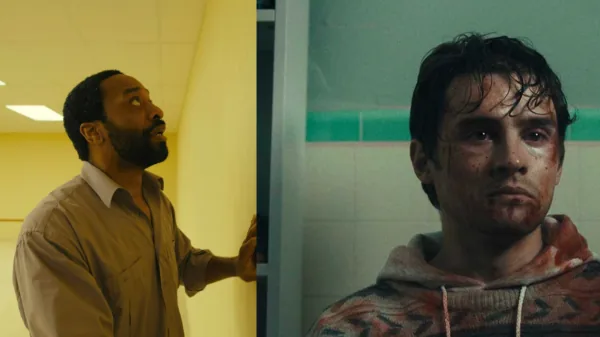
🔥 You Watched Disclosure Day. Now What?
You walked out of Disclosure Day on Friday evening. Emily Blunt's face is still in your head. John Williams' score is still running through your chest. And something about the way the film presented its government — the architecture of concealment, the machinery of institutional secrecy, the extraordinary lengths powerful people go to when keeping the truth from the rest of us — has settled into the back of your mind and is refusing to leave.
You are not alone. And you have options.
The government conspiracy thriller is one of cinema's most consistently satisfying genres — precisely because it touches something in us that pure horror or action never quite reaches. The specific dread of not knowing who to trust. The slowly dawning realisation that the systems designed to protect you are also designed to protect themselves. The moment a protagonist understands that the truth they have found is not one that powerful people will permit them to keep.
Here are five films that live in that space — every one of them essential, every one of them immediately streamable, every one of them ready to sustain the very specific paranoia that Disclosure Day has so expertly installed. 🛸
🎬 FILM 1 — ALL THE PRESIDENT'S MEN (1976)
⭐⭐⭐⭐⭐ | Director: Alan J. Pakula | Streaming: Max
📌 The Essential: The film that invented the genre as we know it — and still its greatest achievement.
🎬 Why It Belongs Here
Before The Parallax View, before Three Days of the Condor, before every government conspiracy thriller that followed — there was All the President's Men. Alan J. Pakula's reconstruction of how Bob Woodward and Carl Bernstein uncovered the Watergate scandal is the genre's foundational text. Not because it invented the territory but because it defined the grammar.
Robert Redford and Dustin Hoffman play Woodward and Bernstein with a specific, unglamorous energy that was radical at the time and remains rare now — two men who are smart but not infallible, diligent but not superhuman, following the money with the persistent, grinding, uncinematic labour that actual journalism requires. There are no car chases. There are no action sequences. There is just two men making phone calls, knocking on doors, and slowly, terrifyingly, understanding what they have found.
The film works because Pakula treats the conspiracy not as a dramatic backdrop but as an institutional reality — something that happened not because of individual evil but because of the way powerful systems protect themselves. The most chilling element is not any single revelation but the accumulating sense that the machinery of concealment operates at a scale that dwarfs any individual's ability to fully comprehend it.
Disclosure Day — with its vision of government secrets as a living, self-protecting architecture — is directly in this tradition. Watch All the President's Men immediately after and understand where that tradition began. 📰
💬 "The most important political film ever made. And somehow still the most urgently watchable."
🎬 FILM 2 — ENEMY OF THE STATE (1998)
⭐⭐⭐⭐ | Director: Tony Scott | Streaming: Netflix
📌 The Accessible: A surveillance thriller that predicted the post-9/11 world four years before it arrived — and gets more relevant every year.
🎬 Why It Belongs Here
Tony Scott directing Will Smith as a labour lawyer accidentally caught with evidence of a government murder — pursued across the entire surveillance apparatus of the American state — is one of the most pure, most propulsive, most ruthlessly efficient thriller experiences of the 1990s.
What makes Enemy of the State feel prescient in 2026 is its specific depiction of surveillance technology. Made in 1998, the film imagined a government capability — total visibility across telephone calls, satellite feeds, financial transactions, movement data — that felt like science fiction at the time. By 2013 it was confirmed as current reality. By 2026 it feels like an understatement.
Gene Hackman's deeply cautious former NSA operative — who has been hiding from the system for decades and understands exactly how it works — is the film's spiritual core. His specific paranoia, earned through decades of knowing what the system is capable of, is the film's most honest element. He is not afraid of the system because he is irrational. He is afraid of it because he has been inside it and has no remaining illusions.
Disclosure Day deals with institutional secrets at an extraterrestrial scale. Enemy of the State deals with them at an intimate, human, domestic scale. Both films understand the same fundamental truth: the information the government chooses not to share with you has consequences for your life whether you know about it or not. 📡
💬 "The surveillance thriller that told us everything about the world we were about to live in — in 1998."
🎬 FILM 3 — MUNICH (2005)
⭐⭐⭐⭐½ | Director: Steven Spielberg | Streaming: Peacock
📌 The Spielberg Connection: The film that proved Spielberg could do moral ambiguity at the highest level — a direct ancestor of Disclosure Day.
🎬 Why It Belongs Here
This one has a specific added resonance in the week of Disclosure Day's release: it is also directed by Steven Spielberg. And it is the film that most directly demonstrates the creative journey that leads from his earlier work to what he has accomplished in 2026.
Munich follows the covert Israeli operation — authorised at the highest levels of government — to hunt and assassinate the perpetrators of the 1972 Olympic massacre. Eric Bana plays the operation's leader — a man who begins with moral clarity and ends with something far less comfortable. A man who carries out the mission he was given and cannot live with what the mission reveals about both his government and himself.
The government in Munich is not evil. That is the film's most unsettling quality. The government is making decisions that it believes are rational, necessary, and just. The horror of what unfolds is that it is possible to agree with the decisions and still be completely destroyed by their consequences. Spielberg is asking something about institutional authority and individual conscience that Disclosure Day asks differently but equally seriously: what do governments conceal from us, and what does concealment cost everyone involved?
Munich is the most morally complex film in Spielberg's catalogue. It is also one of the finest. 🌍
💬 "The film where Spielberg proved he could sit with ambiguity and not resolve it cleanly. An essential step toward Disclosure Day."
🎬 FILM 4 — ZERO DARK THIRTY (2012)
⭐⭐⭐⭐ | Director: Kathryn Bigelow | Streaming: Prime Video
📌 The Modern Classic: The most procedurally honest film about how governments actually keep secrets — and what it costs them to keep them.
🎬 Why It Belongs Here
Kathryn Bigelow's reconstruction of the decade-long CIA hunt for Osama Bin Laden is the most procedurally accurate major studio film about institutional secrecy in modern cinema. Jessica Chastain's Maya — the analyst who becomes increasingly, terrifyingly convinced of her intelligence and increasingly isolated within the system she serves — is one of the finest performances of the 2010s.
What Zero Dark Thirty understands — and communicates with documentary-like precision — is that government secrets are not monolithic. They are distributed, compartmentalised, contradictory, and fiercely defended within the institution itself. The people who hold pieces of the truth are not always communicating with the people who hold the other pieces. The system protects its secrets not through malicious design but through the structural complexity of keeping thousands of people operating on different levels of information simultaneously.
Disclosure Day imagines what happens when that complexity is legally mandated to dissolve — when all the compartments are required to open at once. Zero Dark Thirty shows you what those compartments look like from the inside. The two films are, in their different ways, about the same thing: information as power, and the extraordinary human cost of its management. 🔍
💬 "The most honest film about how government secrecy actually works. Still unsettling. Still essential."
🎬 FILM 5 — DON'T LOOK UP (2021)
⭐⭐⭐½ | Director: Adam McKay | Streaming: Netflix
📌 The Satirical Entry: Because sometimes the most devastating take on institutional concealment is comedy — and nobody does it more painfully than McKay.
🎬 Why It Belongs Here
The tonal wildcard of this list — and deliberately so. Adam McKay's satirical disaster comedy about two astronomers (Leonardo DiCaprio and Jennifer Lawrence) who discover a comet heading directly for Earth and cannot get the government, the media, or the public to take it seriously is a different kind of government conspiracy thriller. The conspiracy here is not one of active deception but of institutional negligence, media complicity, and collective denial.
The government in Don't Look Up is not hiding the truth because it is nefarious. It is hiding the truth because the truth is inconvenient for the news cycle, uncomfortable for the approval rating, and incompatible with the short-term thinking that defines how democratic institutions actually operate. This is, in its own comedic and devastating way, more frightening than any covert operation.
Disclosure Day posits a world where a government-mandated transparency day forces the truth into the open. Don't Look Up is the film about what happens when the truth is available and nobody wants it anyway. The two films are bookends to the same question — not just "can governments keep secrets?" but "does it matter if they can't?" 🌍
💬 "The most relevant film of the decade. A comedy that makes you feel like screaming. Absolutely essential."
📊 The Complete Guide
| 🎬 Film | 📅 Year | 📊 Rating | 🎭 Tone | 📺 Stream |
|---|---|---|---|---|
| All the President's Men | 1976 | ⭐⭐⭐⭐⭐ | Serious / Journalistic | Max |
| Enemy of the State | 1998 | ⭐⭐⭐⭐ | Thriller / Propulsive | Netflix |
| Munich | 2005 | ⭐⭐⭐⭐½ | Moral / Complex | Peacock |
| Zero Dark Thirty | 2012 | ⭐⭐⭐⭐ | Procedural / Intense | Prime Video |
| Don't Look Up | 2021 | ⭐⭐⭐½ | Satirical / Dark Comedy | Netflix |
💬 What People Are Saying — The Disclosure Day Aftermath
💬 "Walked out of Disclosure Day and immediately started All the President's Men. Spent 6 hours in government conspiracy content and I regret nothing." 🔥
💬 "Enemy of the State predicted everything and nobody listened. Adding it to the post-Disclosure Day watchlist immediately." 📡
💬 "Munich and Disclosure Day are the same director asking the same question at two different points in his career. The conversation between them is extraordinary." 🎬
💬 "Don't Look Up on this list is the correct and also devastating choice. Sometimes the conspiracy is just bureaucratic cowardice." 😔
💬 "Zero Dark Thirty shows you how the compartments work. Disclosure Day shows you what happens when they all open. Watch them back to back. Sleep never." 😰
📌 Final Word
🎯 Disclosure Day has arrived and installed a very specific, very productive paranoia in a very large number of cinema audiences. These five films will sustain and deepen it beautifully — from All the President's Men's journalistic rigour to Don't Look Up's satirical devastation. The government conspiracy thriller is one of cinema's most honest genres because it asks the question every citizen has some version of: what are the people in charge not telling me? These five films offer five different, equally compelling answers. 🛸🎬